
The Omega dream team: EPAX Omega 3-9-11


INTRODUCING EPAX® OMEGA 3-9-11
The North Atlantic Ocean is home to pelagic fish with a unique composition of fatty acids. Unlike fish in warmer waters, these fish boast a healthy amount of the long-chain polyunsaturated Omega-3 fatty acids, plus an unusually high content of long-chain monounsaturated fatty acids (LC-MUFA); Omegas 9 and 11.
Applying our gentle and targeted distillation process Epax® EQP+ Tech, we have been able to isolate and increase the content of both the well-known Omega-3s EPA (C20:5 n-3), and DHA (C22:6 n-3) as well as the less well known LC-MUFAs Omega-9 gondoic acid (C20:1 n-9) and Omega-11 cetoleic acid (C22:1 n-11). In total these fatty acids make up a minimum of 720mg/g of EPAX® Omega 3-9-11.
A WORLD OF LIPIDS
Lipids, proteins and carbohydrates are the main macronutrients in our diet. Every cell in a human has a lipid membrane holding the cell together and controlling the passage of molecules in and out of the cell. Lipids are also used as hormones and they are a vital, storable source of energy. Lipids prevent us from drying out and are essential for vision and for brain development and brain health. But lipids can also be involved in diseases due to excessive intake of unhealthy lipids such as saturated fats. Excessive lipid intake can result in obesity and metabolic syndrome.
Lipids come in all shapes and sizes
Lipids are carbon chains. The shortest is acetic acid (C2), commonly known as vinegar, and as the chain length increases, the lipids become less water soluble, more oily and at very long lengths they can become waxy. Lipids can be saturated, monounsaturated or polyunsaturated. Saturation describes the nature of the chemical bonds, with an unsaturated lipid having a free site for new bonds to other atoms, for example oxygen. Therefore, unsaturated lipids are more prone to oxidation than a saturated lipid.
The polyunsaturated long-chain fatty acids EPA and DHA are well known for their health benefits, for example for heart and brain health. Omega-3s incorporate into cells throughout the body and thereby have essential roles in different organs and in overall health. Indeed, a study on the Omega-3 Index shows that a higher index (>8%) is associated with reduced risk for overall mortality, cancer mortality, and cardiovascular mortality (1).
But Omega-3 lipids may be only the beginning. Other lipids such as long-chain monounsaturated Omega-9 and Omega-11, found in high levels in North Atlantic fish, may also have health benefits and some of these are complementary to Omega-3 effects.
EXPLORING THE SCIENCE
Back in the 1960s, a multinational epidemiological study (2) led to the discovery that long-chain monounsaturated fatty acids (LC-MUFAs) derived from fish such as mackerel and herring had positive health effects, particularly in relation to heart health. This study boosted the general interest in monounsaturated fatty acids, and promoted the Mediterranean diet, high in oleic acid (a monounsaturated fatty acid), as one of the healthiest diets (2, 3).
Deep dive: Skin health
Skin health is one of the key areas of interest for EPAX® Omega 3-9-11. EPA and DHA supplementation has been shown to reduce skin inflammation. As an example of this, sun sensitivity was reduced in study participants taking Omega-3 (4) and detailed work by the laboratory of Anne Nicolaou has mapped exactly how EPA and DHA affect the lipidome of the skin during UV exposure (5). There is also a history of LC-MUFA involvement in skin. Intake of oleic acid reduces skin photoaging (6) and monounsaturated fatty acids may play a role in skin antiaging through their anti-inflammatory and anti-oxidising activity (7).
The LC-MUFAs Omega-11 cetoleic acid and Omega-9 gondoic acid are anti-inflammatory. Work in pre-clinical models suggests that cetoleic and gondoic acid accumulate in fat tissue (adipose tissue) and show anti-inflammatory activity (8, 9).
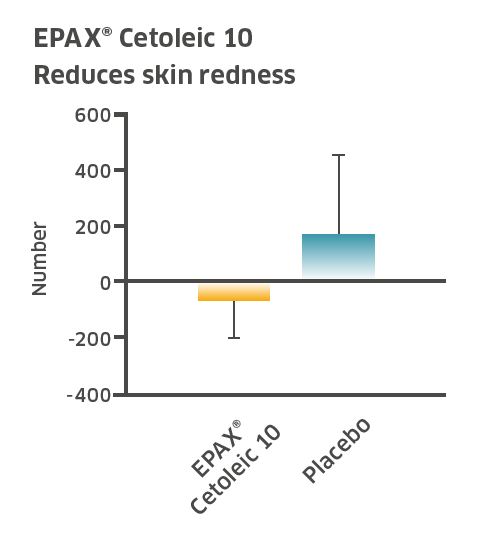
In preclinical studies where the skin lacks the ability to make MUFA, the skin is characterised with poorly developed sebaceous glands which normally keep the skin from drying (10). This provides an indication of the importance of MUFA in skin biology. Epax has run a pilot trial with 24 women randomised to our Omega-9 and Omega-11 rich oil EPAX® Cetoleic 10 or corn oil placebo in a double blind, placebo controlled, randomised study to assess effects on healthy skin (Optihud, NCT05128240) (11). In this study, the redness of skin was statistically significantly reduced in those taking EPAX® Cetoleic 10 compared to placebo. Redness of skin may be a proxy marker of inflammation. This indicates that LC-MUFA can be beneficial to skin health and has prompted further research in this area. See Figure 1.
Deep dive: Inflammation
The Omega-3 fatty acids EPA and DHA have broad acting antiinflammatory activity. In this case, “broad acting” means that Omega-3s can influence inflammation throughout the body. These fatty acids are incorporated into cell membranes affecting signalling molecules that down regulate production of inflammatory cytokines and act as precursors to Specialised Pro-resolving Mediators and endocannabinoids, the latter being important in brain health. Various mechanisms can be employed by the body to balance inflammation and resolution in order to maintain a healthy response to pathogens without the damaging effects of chronic inflammation. Examples of these mechanisms are modulations of anti-inflammatory (e.g cytokines, IL-4, 6, 10 etc), anti-inflammatory immune cells (Treg cells, Th2 cells), short chain fatty acids (propionate and butyrate), Omega-3 fatty acids and their resolvins.
LC-MUFAs such as Omega-11 cetoleic acid also have well documented anti-inflammatory activity. Whilst the mechanism of action of cetoleic acid is less well known, there is substantial preclinical evidence that cetoleic oils are part of dietary normalisation of endothelial, adipocyte and likely epithelial inflammation (9, 12, 13).
LC-MUFAs may affect inflammation in a number of ways. Similar to EPA and DHA, LC-MUFAs bind to PPAR nuclear receptors (13, 14). These nuclear receptors affect gene expression that leads to reduction of lipids in the liver and blood (PPAR-α), reduction in expression of pro-inflammatory cytokines (PPAR-γ) and promotion of macrophage switching to a non-inflammatory phenotype (M2) (15, 16). LC-MUFA may also increase the Omega-3 to Omega-6 ratio in blood plasma (17, 18).
Deep dive: The Omega-3 Index
The Omega-3 Index is a measure of the EPA and DHA content in red blood cells. This is a validated risk score for heart health where a score of 4% or less is associated with increased risk of coronary heart disease, whereas values of 8 or above are associated with low risk. The index is mostly reflective of dietary EPA and DHA, but there is also some conversion of alpha linolenic acid (ALA) to the longer chain EPA. This conversion is modest, and in men less than 5% of ALA is converted, whereas in women the conversion rate is approximately 8%.
Pure Omega-11 cetoleic acid has been shown to increase the conversion of ALA to EPA and DHA. This was confirmed using radiolabelled ALA in liver cell cultures. Epax has repeated this study with similar results in a canine hepatic cell line (19). This is further supported by a human study with LC-MUFA performed in the Czech republic (20). Here, 100 subjects received an oil with high levels of cetoleic acid over a 6-month period. The Omega-3 Index rose from an average of 5.1% to 10.7%. The study was not controlled, however, use of an algorithm to predict the Omega-3 Index based on EPA and DHA content in the LC-MUFA oil suggests the oil should have provided an index of 6.6% (21). Whilst this study has the limitation of not having a placebo control, the results show a clearly unexpected high increase in index level after supplementation with a cetoleic/gondoic oil.
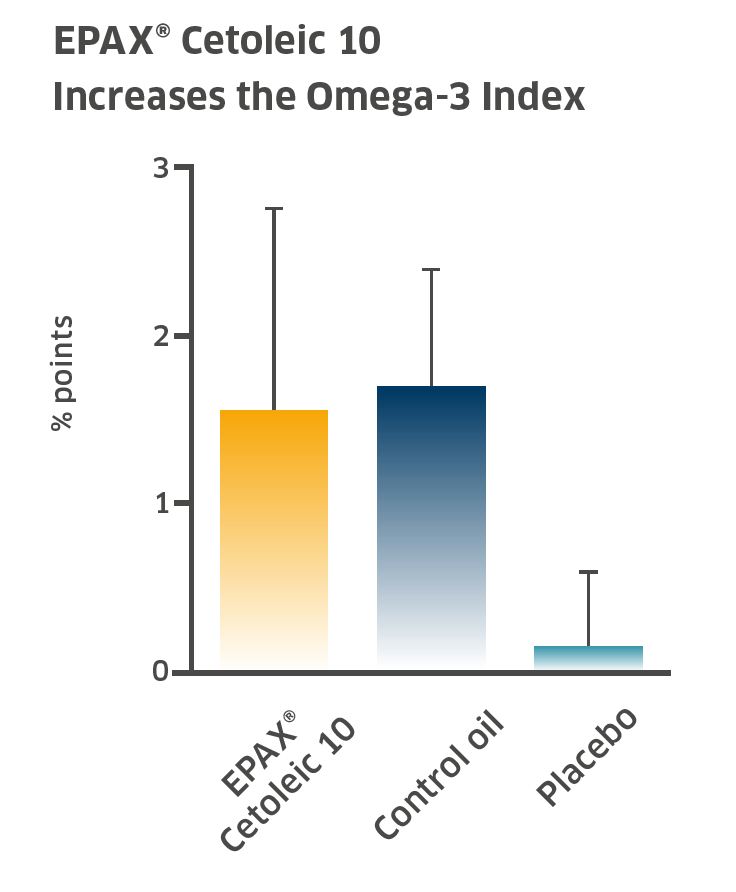
Epax has also performed a placebo-controlled, randomised, interventional study to determine the effect of LC-MUFA on the Omega-3 Index (CetoIndex, NCT04768595) (22). The average baseline Omega-3 value was 5.8 – 6.1 and rose by 1.6% points with LC-MUFA. This increase was equivalent to a control Omega-3 oil despite the Omega-3 oil containing 23% more EPA+DHA.
Deep dive: Metabolic health
Preclinical research with LC-MUFA oils (with particularly high Omega-3, 9 and 11 lipids) have largely focused on the role of these oils in metabolic health. Beneficial effects on atherosclerotic plaques, plasma lipid levels, insulin sensitivity and glucose levels have been demonstrated in animal models (12, 13, 23). The first human trial with such an LC-MUFA Omega-3 oil led to normal healthy levels of triglycerides and cholesterol and confirmed that intake of high LC-MUFA levels (up to 3.5g LC-MUFA was tested) were safe and well tolerated in humans (24).
OMEGA 3-9-11, THE BEST OF BOTH WORLDS
Omega-9 and Omega-11 LC-MUFAs are known to induce anti-inflammatory pathways and have effects on adipose tissue. Studies in metabolic health involving cholesterol and triglyceride measurements in liver cell culture show metabolic parameters were improved to a greater extent with a combination of LC-MUFA and EPA/DHA than with each lipid alone (25). This finding was confirmed in preclinical studies again in metabolic health showing that there was a combined effect of the lipids, possibly due to EPA/DHA effects on liver and LC-MUFA on adipose tissue (9). Therefore, EPAX Omega 3-9-11 brings together the best of mono- and polyunsaturated bioactive lipids.
Exploring opportunities
Epax is supporting further research into healthy skin with support of a study in eczema. Recruitment started in Q1 of 2024 of a randomised, placebo controlled, blinded evaluation of the effect of LC-MUFA in subjects with mild to moderate eczema. This study will also perform advanced lipidomic analysis of skin to determine changes elicited from LC-MUFA intake (ClinicalTrials.gov NCT06194045).
Epax has for many years been a partner of choice for research-ers across the world and we intend to continue with this and increase our research portfolio to include our oils enriched in LC-MUFA. Epax LC-MUFA oils are currently being used in a series of university research projects with particular focus on cardiometabolic effects. Researchers are welcome to contact us with requests for these oils.
Epax is excited to welcome EPAX® Omega 3-9-11 to its portfolio, and its launch helps support our vision of creating new opportu-nities from marine ingredients. Scientific research is in early days in terms of understanding the health benefits that LC-MUFA can offer and it’s clear there is still more to discover. At Epax, we will continue to work with researchers to look at its potential effects in many areas of health, including heart health, metabolic health, and skin health. This all shows that EPA and DHA – and all the scientific evidence to show their health benefits – are just part of the story. In reality, we are only just beginning to understand the scale of the potential of marine lipids.
References
1. Harris, W.S., et al., Blood n-3 fatty acid levels and total and cause-specific mortality from 17 prospective studies. Nat Commun, 2021. 12(1): p. 2329.
2. Fung, T.T., et al., Mediterranean diet and incidence of and mortal-ity from coronary heart disease and stroke in women. Circulation, 2009. 119(8): p. 1093-100.
3. Samieri, C., et al., The association between dietary patterns at midlife and health in aging: an observational study. Ann Intern Med, 2013. 159(9): p. 584-91.
4. Pilkington, S.M., et al., Omega-3 polyunsaturated fatty acids: photoprotective macronutrients. Exp Dermatol, 2011. 20(7): p.537-43.
5. Kendall, A.C., et al., Dynamics of the human skin mediator lipidome in response to dietary ω-3 fatty acid supplementation. Faseb j, 2019. 33(11): p. 13014-13027.
6. Latreille, J., et al., Dietary monounsaturated fatty acids intake and risk of skin photo-aging. PLoS One, 2012. 7(9): p. e44490.
7. Solway, J., et al., Diet and Derma-tology: The Role of a Whole-food, Plant-based Diet in Preventing and Reversing Skin Aging-A Review. J Clin Aesthet Dermatol, 2020. 13(5): p. 38-43.
8. Yang, Z.H., et al., Dietary supplementation with long-chain monounsaturated fatty acids attenuates obesity-related metabolic dysfunction and increases expression of PPAR gamma in adipose tissue in type 2 diabetic KK-Ay mice. Nutr Metab (Lond), 2013. 10(1): p. 16.
9. Yang, Z.H., et al., Long-term dietary supplementation with saury oil attenuates metabolic abnormalities in mice fed a high-fat diet: combined beneficial effect of omega-3 fatty acids and long-chain monounsaturated fatty acids. Lipids Health Dis, 2015. 14: p. 155.
10. Miyazaki, M., W.C. Man, and J.M. Ntambi, Targeted disruption of stearoyl-CoA desaturase1 gene in mice causes atrophy of sebaceous and meibomian glands and deple-tion of wax esters in the eyelid. J Nutr, 2001. 131(9): p. 2260-8.
11. Mildenberger J, M.L., Optihud: A nutritional, single centre, placebo controlled, randomised, blinded study of the effect of mackerel oil on skin quality and omega-3 index. 2022, Møreforsking.
12. Yang, Z.H., et al., Beneficial effects of dietary fish-oil-derived monounsaturated fatty acids on metabolic syndrome risk factors and insulin resistance in mice. J Agric Food Chem, 2011. 59(13):p. 7482-9.
13. Yang, Z.H., et al., Long-chain monounsaturated fatty acid-rich fish oil attenuates the develop-ment of atherosclerosis in mouse models. Mol Nutr Food Res, 2016. 60(10): p. 2208-2218.
14. Yang, Z.H., B. Emma-Okon, and A.T. Remaley, Dietary marine-derived long-chain monounsaturated fatty acids and cardiovascular disease risk: a mini review. Lipids Health Dis, 2016. 15(1): p. 201.
15. Song, M.Y., et al., Enhanced M2 macrophage polarization in high n-3 polyunsaturated fatty acid transgenic mice fed a high-fat diet. Mol Nutr Food Res, 2016. 60(11): p. 2481-2492.
16. Chang, H.Y., et al., Docosahexae-noic acid induces M2 macrophage polarization through peroxisome proliferator-activated receptor γ activation. Life Sci, 2015. 120:p. 39-47.
17. Halvorsen, B., et al., Effects of long-chain monounsaturated and n-3 fatty acids on fatty acid oxidation and lipid composition in rats. Ann Nutr Metab, 2001. 45(1): p. 30-7.
18. Østbye, T.K., et al., The long-chain monounsaturated cetoleic acid improves the efficiency of the n-3 fatty acid metabolic pathway in Atlantic salmon and human HepG2 cells. Br J Nutr, 2019. 122(7): p. 755-768.
19. Ruyter, B., et al., Effekt av ketolinsyre på omega-3 metab-olismen i leverceller fra hund. 2021, NOFIMA.
20. Stankova B, T.E., Bayerova H, Bryhn AC, Bryhn M, Herring oil intake results in increased levels of omega-3 fatty acids in eryth-rocytes in an urban population in the Czech Republic. Arch Med Sci Civil Dis, 2018: p. e3-e9.
21. Walker, R.E., et al., Predicting the effects of supplemental EPA and DHA on the omega-3 index. Am J Clin Nutr, 2019. 110(4): p. 1034-1040.
22. Midtbø LK, M.J., CetoIndex. A nutritional, single centre, placebo controlled, randomised, blinded study of the effect of different fish oils on omega-3 index. 2022, Møreforsking.
23. Yang, Z.H., et al., Dietary supplementation with long-chain monounsaturated fatty acid isomers decreases atherosclerosis and alters lipoprotein proteomes in LDLr(-/-) mice. Atherosclerosis, 2017. 262: p. 31-38.
24. Yang, Z.H., et al., Supplementation with saury oil, a fish oil high in omega-11 monounsaturated fatty acids, improves plasma lipids in healthy subjects. J Clin Lipidol, 2020. 14(1): p. 53-65.e2.
25. Yoshinaga, K., et al., Simulta-neous Treatment of Long-chain Monounsaturated Fatty Acid and n-3 Polyunsaturated Fatty Acid Decreases Lipid and Cholesterol Levels in HepG2 Cell. J Oleo Sci, 2021. 70(5): p. 731-736.
This white paper presents scientific findings and areas of scientific research with LC-MUFA/cetoleic acid. These statements have not been evaluated by the Food and Drug Administration. This product is not intended to diagnose, treat, cure, or prevent any disease.