
Beyond Omega-3: EPAX Evolve 05


Background about VLC-PUFA
EPA (Eicosapentaenoic Acid) and DHA (Docosahexaenoic Acid) are the best-known Omega-3 fatty acids, with an extensive body of scientific literature documenting their many health benefits.
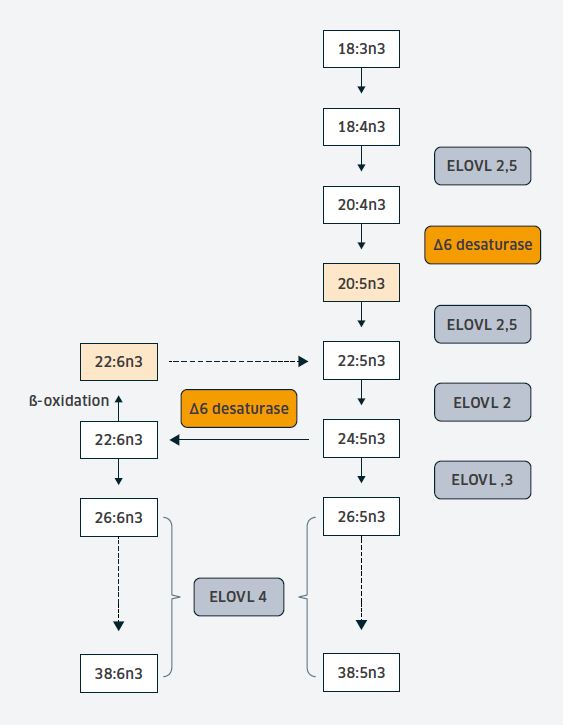
Much less familiar are the Very Long Chain Polyunsaturated Fatty Acids (VLC-PUFA) which are extensions of EPA and DHA. For the purpose of this paper, when talking about VLC-PUFAs, we refer to fatty acids with a chain length of ≥24 carbon atoms. A major difference between EPA/DHA and VLC-PUFAs is that whilst EPA/DHA mostly originate from our diet, VLC-PUFAs are provided for in the body by the action of a set of proteins known as ELOVL. This family of enzymes creates a host of different fatty acids depending on the specific need of each tissue. ELOVL2 is a key enzyme in the synthesis of VLC-PUFA beyond C20 and ELOVL4 for VLC-PUFA beyond C24; [1] the bio-synthetic pathway for this is shown in Figure 1.
About EPAX Evolve 05
EPAX Evolve 05 is a new patent-protected, marine-based Omega-3 concentrate containing high levels of VLC-PUFAs, which are controlled to give a 10× concentrate compared to natural fish oil.
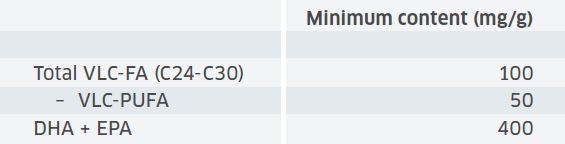
EPAX Evolve 05 has been tested in animal models to determine absorption and accumulation in target tissues after supplementation. In this research, feeding led to accumulation of VLC-PUFAs in the meibomian glands, testes and other relevant tissues[5]. This is an important finding, which supports the use of EPAX Evolve 05 as a nutritional supplement. Studies to date have been hindered by the lack of a product containing significant amounts of VLC-PUFA. Now however, EPAX Evolve 05’s high levels of VLC-PUFA mean it can be used in human intervention trials for the first time.
VLC-PUFA and longevity
EPAX Evolve 05 can be considered as boosting the product of ELOVL2 protein activity. This offers the tantalising prospect of it being used in cases where ELOVL2 activity is reduced, such as ageing (no other gene is as tightly associated with ageing as ELOVL2). Methylation is one of several ways in which cells can switch genes on and off. In general, DNA methylation increases with age, leading to less gene transcription, but this is especially true for ELOVL2. The methylation of ELOVL2 is so strongly associated with age that it has been suggested as an independent forensic test for determining chronological age[6]. In animal studies where the ELOVL2 gene is knocked out (resulting in no ELOVL2 protein) the concomitant reduction in VLC-PUFAs is associated with a series of age-related phenotypes such as hair loss, muscle loss, reduced bone density, cognitive decline and premature death[7]. Several papers now show that decreased ELOVL2 activity is responsible for age-related visual changes. In 2024, a breakthrough study was performed using a fish-derived VLC-PUFA oil for oral intake, which led to improved retinal function. This study not only demonstrates the potential role of supplementation in the rescue of vision but also provides an important example of the ways in which supplemental VLC-PUFA can affect the structure and function of the body, resulting in a health benefit.
VLC-PUFA in vision
VLC-PUFAs are essential for vision. This has been shown in studies that identified mutations in the ELOVL4 gene as responsible for Stargardt 3, a juvenile, progressive eye disease leading to severely impaired vision.[8] ELOVL4 protein is present in the pigmented retinal epithelium, a layer that is metabolically highly active with a highly oxidative environment. VLC-PUFAs are present as phospholipids at the sn-2 position with DHA on the adjacent sn-1 arm[9] and contribute to cell survival.[2] Preclinical studies have demonstrated that ELOVL2 gene expression is down-regulated with ageing due to methylation, and that this correlates with age-related visual impairment[10]. A synthetic C32 VLC-PUFA was used in a feeding study with a knock-out model for blindness. In these animals, feeding led to improvement in visual acuity[11]. More recently, a C24:5 lipid injection was used in a pre-clinical model to reverse age-related visual decline[12], and an animal feeding study showed similar improvements in visual response from a fish-derived VLC-PUFA oil[13].
Therefore, these pre-clinical studies provide several important findings:
- Age-related visual decline and macular degeneration are associated with methylation of the ELOVL2 gene and reduced levels of VLC-PUFA.
- Supplementation with VLC-PUFAs can lead to improved visual acuity.
- There is a strong likelihood that VLC-PUFA triglycerides in the diet undergo further processing by the body into the phospholipid form thought to be important in vision.
VLC-FA in dry eye disease
Tears are highly complex structures, containing over 200 lipids, proteins, salts, sugars, and even antibodies[14]. They are composed of three layers, the outermost being a thin lipid film containing cholesteryl esters, wax esters and triacylglycerols, which prevents the inner water layer from evaporating.[15] Cholesteryl esters make up over 70% of tear lipids and these contain a very high content of VLC-FA, predominantly with a chain length between C24 and C27[16]. Additionally, O-acyl hydroxy fatty acids (OAHFA) contain VLC-MUFA (Very Long Chain Monounsaturated Fatty Acid) between C28-C34. OAHFA provide important structural functions in the tear and have also been shown to be of high importance in the barrier function of the skin[14]. More recently, analysis of human tears has identified OAHFAs containing VLC-PUFAs [17], although their function in this context has not yet been established.
Genetic knock-out of ELOVL genes has demonstrated the importance of VLC-FAs in maintaining a healthy tear structure, which is important for optimal eye health. Knock-out of ELOVL1 led to a shift in the length and ratio of VLC-FAs in the meibum, resulting in reduced chain length of saturated VLC-FAs, and reduced amounts of VLC-MUFA[15]. Animals with an ELOVL1 knock-out present with symptoms of dry eye suggesting that VLC-FAs are an important factor in Dry Eye Disease. Homozygous ELOVL4 knock-out animals showed changes in the lipid composition of the meibum and also presented with meibomian gland dysfunction which suggests a structural and functional role of VLC-FA in meibum production and gland physiology[16].
The working hypothesis is that supplementation with EPAX Evolve 05 will lead to increased accumulation of VLC-FAs in the meibomian glands and increase production of lipids containing VLC-FA to promote a healthier lipid layer in those with dry eye symptoms.
VLC-PUFA in male fertility
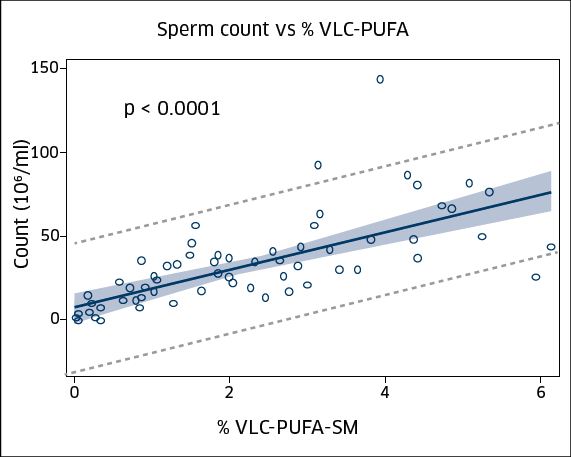
Epax is proud to have begun the first interventional study with a commercial VLC-PUFA formulation (EPAX Evolve 05). It will be performed on men attending a fertility clinic to determine the effect of VLC-PUFA supplementation on sperm quality. Sperm are rich in lipids known as sphingomyelins (SM), and more than 70% of the acyl groups of sperm sphingomyelin are VLC-PUFAs[18]. Lipidomic analysis performed during spermatogenesis and use of knock-out animals supports the essential role of VLC-PUFAs in sperm maturation, and in particular in the initiation of spermatogenesis and Sertoli-cell-spermatid interactions[19]. Two human studies have shown that the concentration of VLC-PUFA in sperm samples associates with sperm number, motility and morphology [20, 21].
Regulatory status
EPAX Evolve 05 has been designated as not novel in the EU. For the US market it received GRAS status in 2024. Future work Epax is committed to advancing knowledge on these novel lipids, and plans additional human clinical studies, the results of which we hope will support claims for EPAX Evolve 05 as a dietary supplement. We are in close dialogue with leading researchers in the field of VLC-PUFA biology.
Summary
- VLC-PUFA levels are strongly associated with ageing
- VLC-PUFAs have been shown to reduce age associated decline in vision
- Oral supplementation with EPAX Evolve 05 leads to VLC-PUFA accumulation in target tissues, including the meibomian glands and testes
- Exciting prospects lie ahead, with the first-in-human clinical studies already under way
References
1. Gyening, Y.K., et al., ELOVL4 Mutations That Cause Spinocerebellar Ataxia-34 Differentially Alter Very Long Chain Fatty Acid Biosynthesis. J Lipid Res, 2023. 64(1): p. 100317.
2. Yeboah, G.K., et al., Very long chain fatty acid-containing lipids: a decade of novel insights from the study of ELOVL4. J Lipid Res, 2021. 62: p. 100030.
3. Aldahmesh, M.A., et al., Recessive mutations in ELOVL4 cause ichthyosis, intellectual disability, and spastic quadriplegia. Am J Hum Genet, 2011. 89(6): p.745-50.
4. Diociaiuti, A., et al., Two Italian Patients with ELOVL4-Related Neuro-Ichthyosis: Expanding the Genotypic and Phenotypic Spectrum and Ultrastructural Characterization. Genes (Basel), 2021. 12(3).
5. Torrissen, M., et al., Deposition and metabolism of dietary n-3 very-long-chain PUFA in different organs of rat, mouse and Atlantic salmon. Br J Nutr, 2021: p. 1-20.
6. Paparazzo, E., et al., An ELOVL2-Based Epigenetic Clock for Forensic Age Prediction: A Systematic Review. Int J Mol Sci, 2023. 24(3).
7. Li, X., et al., Lipid metabolism dysfunction induced by age-dependent DNA methylation accelerates aging. Signal Transduct Target Ther, 2022. 7(1): p. 162.
8. Agbaga, M.P., et al., Role of Stargardt-3 macular dystrophy protein (ELOVL4) in the biosynthesis of very long chain fatty acids. Proc Natl Acad Sci U S A, 2008. 105(35): p. 12843-8.
9. Harkewicz, R., et al., Essential role of ELOVL4 protein in very long chain fatty acid synthesis and retinal function. J Biol Chem, 2012. 287(14): p. 11469-80.
10. Chen, D., et al., The lipid elongation enzyme ELOVL2 is a molecular regulator of aging in the retina. Aging Cell, 2020. 19(2): p. e13100.
11. Gorusupudi, A., et al., Retinal bioavailability and functional effects of a synthetic very-longchain polyunsaturated fatty acid in mice. Proc Natl Acad Sci U S A, 2021. 118(6).
12. Gao, F., et al., Polyunsaturated Fatty Acid - mediated Cellular Rejuvenation for Reversing Age-related Vision Decline. bioRxiv, 2024.
13. Yang, Z.H., et al., Dietary fish oil enriched in very-long-chain polyunsaturated fatty acid reduces cardiometabolic risk factors and improves retinal function. iScience, 2023. 26(12): p. 108411.
14. Viitaja, T., et al., Tear Film Lipid Layer Structure: Self-Assembly of O-Acyl-ω-hydroxy Fatty Acids and Wax Esters into Evaporation-Resistant Monolayers. Nano Lett, 2021. 21(18): p. 7676-7683.
15. Sassa, T., et al., Very long-chain tear film lipids produced by fatty acid elongase ELOVL1 prevent dry eye disease in mice. Faseb j, 2018. 32(6): p. 2966-2978.
16. McMahon, A., H. Lu, and I.A. Butovich, A role for ELOVL4 in the mouse meibomian gland and sebocyte cell biology. Invest Ophthalmol Vis Sci, 2014. 55(5): p. 2832-40.
17. Magny, R., et al., Identification of new Omega-3 very long chain poly-unsaturated fatty acids in meibomian gland secretions. Biochimie, 2022. 203: p. 3-10.
18. Furland, N.E., et al., Very long-chain polyunsaturated fatty acids are the major acyl groups of sphingomyelins and ceramides in the head of mammalian spermatozoa. J Biol Chem, 2007. 282(25): p. 18151-18161.
19. Rabionet, M., et al., Male germ cells require polyenoic sphingolipids with complex glycosylation for completion of meiosis: a link to ceramide synthase-3. J Biol Chem, 2008. 283(19): p. 13357-69.
20. Craig, L.B., et al., Decreased very long chain polyunsaturated fatty acids in sperm correlates with sperm quantity and quality. J Assist Reprod Genet, 2019. 36(7): p. 1379-1385.
21. Gavrizi, S.Z., et al., Sperm very long-chain polyunsaturated fatty acids: relation to semen parameters and live birth outcome in a multicenter trial. Fertil Steril, 2023. 119(5): p. 753-760.
22. Santiago Valtierra, F.X., et al., Elovl4 and Fa2h expression during rat spermatogenesis: a link to the very-long-chain PUFAs typical of germ cell sphingolipids. J Lipid Res, 2018. 59(7): p.1175-1189.
23. Zadravec, D., et al., ELOVL2 controls the level of n-6 28:5 and 30:5 fatty acids in testis, a prerequisite for male fertility and sperm maturation in mice. J Lipid Res, 2011. 52(2): p. 245-55.
24. Roqueta-Rivera, M., et al., Docosahexaenoic acid supplementation fully restores fertility delta-6 desaturase-null mice. J Lipid Res, 2010. 51(2): p. 360-7.
This white paper presents scientific findings and areas of scientific research with Very Long Chain Polyunsaturated Fatty Acids.
These findings have not been evaluated by regulatory authorities and do not represent authorised nutritional claims.