
Effect of cetoleic acid on psoriasis

Mono-unsaturated lipids, in particular cetoleic acid, are touted for their beneficial skin effects. A recent report from the Norwegian Research group, NOFIMA, provides mechanistic insights as to how this happens and why it’s a good idea to have both PUFAs and MUFAs.
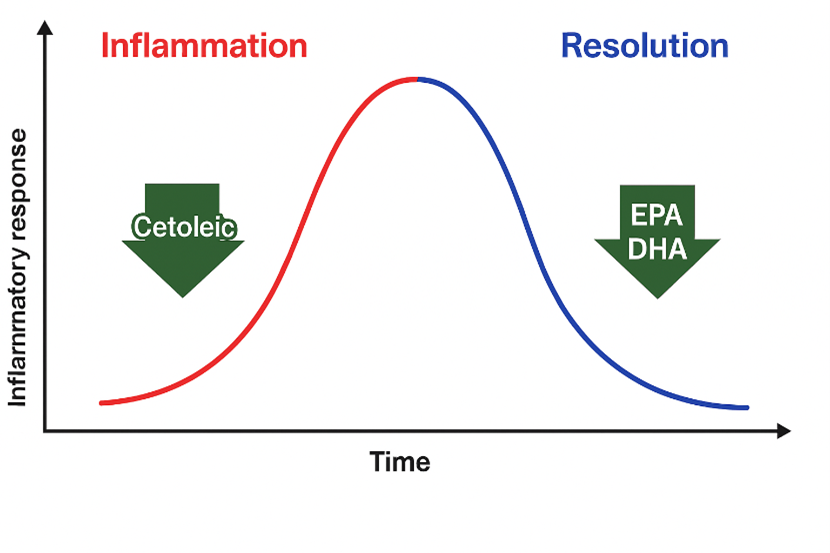
The studies used cell culture and “skin in a lab” 2D and 3D skin models to demonstrate that broadly speaking cetoleic acidacts on the initial phase of inflammation, and that EPA and DHA promote the end phase, known as inflammation-resolution via potent omega-3 products made at the site of inflammation.
This can be summarised by the figure below.
The relevance for skin and psoriasis comes from using skin model systems and a focus on signalling molecules relevant to psoriasis.
But the story continues. The research, led by Tone-Kari Knutsdatter Østbye, demonstrates cetoleic acid having a direct effect on inflammation and improved mitochondrial health in fat cells (adipocytes). These data for cetoleic acid agree with pre-clinical studies using EPAX LCMUFAs which showed potent anti-inflammatory effects in adipose tissue [1].
There are several mechanisms described for omega-3 anti-inflammatory effects. While additional mechanisms may also be relevant, the work by Østbye provides a compelling story within skin health.
The dual action PUFA+MUFA argument described by NOFIMA is an example of why Epax 3-9-11 is the best of both worlds.
The details. For those wanting more.
The report by researcher Tone-Kari Knutsdatter Østbye shows that IL-17 stimulated keratinocytes (HaCat) and a 3D skin model cultured with cetoleic acid have reduced levels of IL-6 and IL-8 and show inhibition of the central signalling pathway normally up-regulated in psoriasis; the IL-17/NF-κB axis. Cetoleic acid also reduced psoriasis-related expression of matrix metalloproteinasesimportant in extracellular matrix remodelling. These are all examples of down-regulation of early inflammatory responses. In contrast, EPA and DHA had no effect on these markers but did increase Specialized Pro-resolving Mediators (SPMs) from DHA, EPA and arachidonic acid.
In primary human subcutaneouspre-adipocytes, Il-8 expression was reduced and ATP production in mitochondria increased with cetoleic acid. The effects of EPA and DHA on adipocytes was largely on the composition and levels of SPMs although DHA increased adiponectin levels in both normal and stressed adipocytes.
To read the entire report you need to speak, or translate, Norwegian. The report will be posted here. https://www.fhf.no/prosjekter/prosjektbasen/901846/
1. Hansen, A., et al., Intake of a cetoleic acid concentratelowered concentrations of markers of inflammation and macrophage infiltrationbut did probably not increase EPA biosynthesis in male obese Zucker fa/fa rats.Br J Nutr, 2025. 134(11): p.881-891.